---
title: "Does Finnish have a future tense? Settled in 1944"
description: "Finnish marks future time with the present tense and a word for when. Whether it is allowed to do anything else has been argued since 1871 and was ruled on in April 1944."
type: "article"
category: "learning-curve"
url: "https://finnishirl.com/blog/does-finnish-have-future-tense"
canonical: "https://finnishirl.com/blog/does-finnish-have-future-tense"
published: "2026-10-28"
updated: "2026-10-28"
author: "Andrey the Nomad"
site: "Finnish IRL"
license: "https://finnishirl.com/terms#ip"
---

# Does Finnish have a future tense? Settled in 1944
URL: https://finnishirl.com/blog/does-finnish-have-future-tense
Date: 2026-10-28
Updated: 2026-10-28
Category: learning-curve
Keywords: does finnish have future tense, finnish future tense, tulla futuuri, how to say tomorrow in finnish, finnish present tense future, finnish verb tenses
Summary: Finnish marks future time with the present tense and a word for when. Whether it is allowed to do anything else has been argued since 1871 and was ruled on in April 1944.

Quick answer:
- No inflectional future, which is the typological answer: the World Atlas of Language Structures files Finnish under no inflectional future. The present tense carries it, with a word for when.
- That is not the same as having no way to talk about the future. The standard grammar devotes a section to expressions with future meaning, and there are several of them.
- The disputed one is the tulla future, tulen tekemään, which purists have called a Swedish import since at least 1871.
- The Finnish Literature Society's language committee ruled on it on 3 April 1944: not to be condemned as sharply as the complainant did, but it turns up unnecessarily often in translated language. That ruling still stands.

What you'll learn:
- What Finnish actually does instead of a future tense, and the one word that does most of the work
- The construction that has been argued about for over 150 years, and who was right
- What a language committee decided in the middle of a war, and why it is still the rule
- The claim about weak-future languages that gets quoted at Finland, and how much weight it bears

Body:

On 3 April 1944 the language committee of the Finnish Literature Society met in Helsinki with a letter on the agenda. It had been sitting unanswered for months, because the war had shut the committee down for the better part of a year, and it had spent that time in a bomb shelter.

The letter was from Oiva Talvitie, editorial secretary of the newspaper <span lang="fi">Kauppalehti</span>, and it was not a neutral enquiry.

<div class="callout callout--sea">
  <div class="callout-head"><span class="callout-title">Talvitie to the committee, 1944</span></div>
  <p>"Since I was small I have lived believing that the Finnish language has only one, single, indivisible and simple future, which when written looks quite deceptively like the present."</p>
  <p>Twenty-one years of writing for print, he said, without once using or even needing a compound future. He had destroyed "an altogether extraordinary quantity" of them in other people's manuscripts. The younger editors he had trained had learned to hate it. <b>"It makes my language instinct crawl."</b></p>
</div>

Then the doubt that made him write: he had begun finding the thing in the prose of language experts he respected. Had Finnish actually been given a compound future? And if so, when was one supposed to use which?[^kielikello]
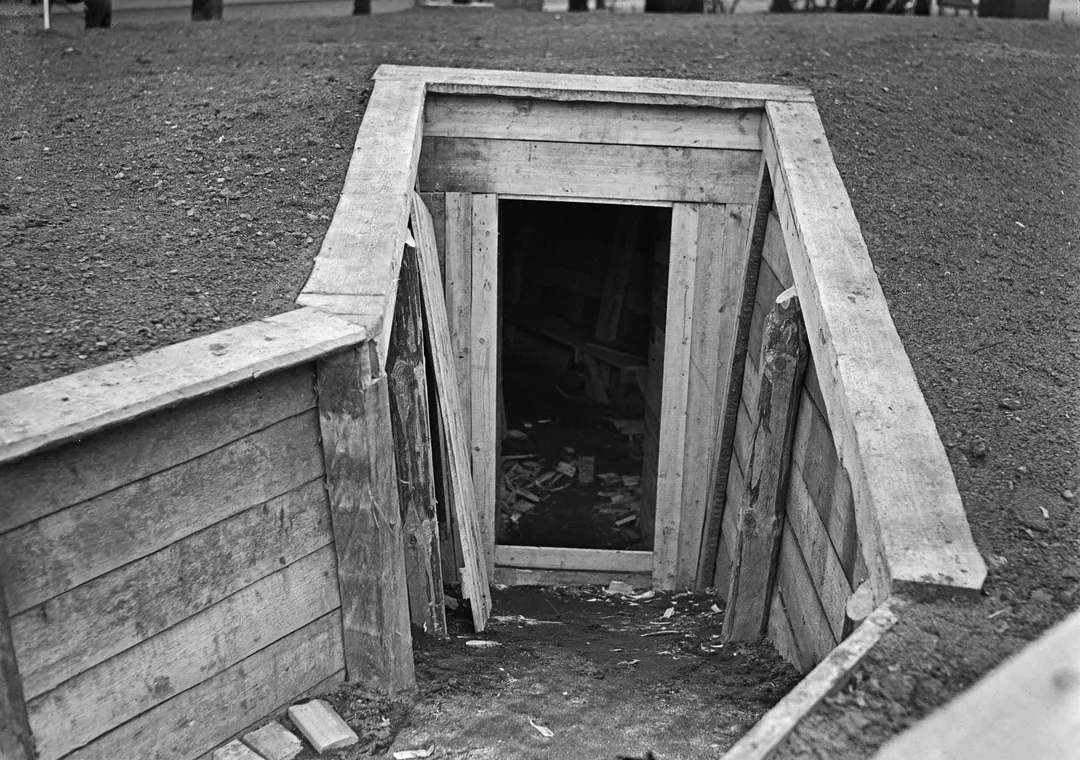
![The wooden entrance to a dug-in bomb shelter in Helsinki in 1939, boards propped against the sides](/images/words/optimized/blog-does-finnish-have-future-tense-1-b8eb5b8ffd-1080.webp "A Helsinki bomb shelter, 1939. Talvitie's letter spent months in one of these before anybody could answer it")

## The short answer, and why it is not the whole answer

Typologically he was right. The World Atlas of Language Structures files Finnish under **no inflectional future**: there is no future tense as a verb form.[^wals] What Finnish has is a present tense that covers both, and a word telling you when.

| Finnish {fi} | English |
| --- | --- |
| Menen huomenna. | I am going tomorrow. |
| Mä meen kohta. | I am going in a minute. |
| Nähdään ensi viikolla. | See you next week. |
| Aion soittaa hänelle. | I intend to call him. |

Nothing in the verbs is marked for future. <span lang="fi">Menen</span> is the same form you would use for right now, and the time word does the work.

But the standard grammar is careful here, and so is the terminology. The Finnish term bank keeps two entries apart: a future *tense* is a verb form, and future *meaning* is what an expression conveys.[^termipankki] Finnish has none of the first and a good supply of the second, and the grammar gives them their own section under exactly that heading.[^kotus-blogi] Talvitie's "one, single, indivisible" future was a stronger claim than the language supports.

<div id="midpost-newsletter-slot"></div>

![The editorial office of the newspaper Uusi Suometar in the nineteenth century, a dozen men around a table covered in proofs](/images/words/optimized/blog-does-finnish-have-future-tense-2-ff9be6d3f6-1080.webp "The Uusi Suometar newsroom. The 1898 argument that the 1944 committee read out had started in this paper's letters column")

## The construction everyone has been arguing about

The disputed one is <span lang="fi">tulla</span> plus a third infinitive: <span lang="fi">tulen lukemaan</span>, <span lang="fi">tulette maksamaan</span>. <span lang="fi">Tulla</span> is an ordinary verb of arriving and becoming,[^ks] so the construction reads literally as "I come to read", and it is the shape that makes anyone who knows Swedish think of <span lang="sv">kommer att</span>.

That suspicion is old. A. W. Jahnsson's *Finska språkets satslära* of 1871 warned against rendering Swedish <span lang="sv">om du kommer att resa dit</span> as <span lang="fi">jos tulet sinne matkustamaan</span>.[^kielikello]

The committee in 1944 did not have Talvitie's letter copied for its members, so instead somebody read out an article from 46 years earlier: Artturi Kannisto's "Kirjakielemme futuurista", published in <span lang="fi">Virittäjä</span> in 1898 and itself written in reply to a newspaper opinion piece.

Kannisto's position was that the purists had the facts wrong. The <span lang="fi">tulla</span> future is not plucked out of the air, he wrote; it has support in the vernacular. He then filled pages with dialect examples, mostly western but eastern too:

<ul class="examples">
  <li class="example">
    <div class="fi" lang="fi">Kyllä te sen tulette maksamaan.</div>
    <div class="en" lang="en">You will pay for that all right.</div>
  </li>
  <li class="example">
    <div class="fi" lang="fi">En tiijä, millä veneellä me tulemme lähtemään.</div>
    <div class="en" lang="en">I don't know which boat we'll be leaving on.</div>
  </li>
</ul>

On Jahnsson's Swedish-import theory Kannisto is brisk: the author probably scented a Swedishism in it, but undoubtedly quite without cause. And on abolishing the construction: it is thoroughly common, and rejecting it would be impoverishing the language.[^kielikello]

## The ruling

The committee took Kannisto's side, with a qualification, and the minutes are worth having in full because the qualification is the part that survived.

> The future formed with the verb <span lang="fi">tulla</span> is not simply to be condemned as sharply as the sender of the letter has done, but especially in translated language it occurs unnecessarily often. Kannisto's arguments were found to be still valid.[^kielikello]

So: not a foreign intrusion, not a mistake, and not neutral either. A construction with vernacular roots that translators reach for far more often than Finnish writers do, because the source text has a future tense and the translator feels the absence.

That is still the working rule eighty years later, and it is why Finnish style guides go on calling the <span lang="fi">tulla</span> future unnecessary rather than wrong. The distinction matters if you are writing Finnish: you will not be corrected for it, and you will sound translated.

![The departure board at Helsinki Central Station, long-distance trains listed with times and destinations](/images/words/optimized/blog-does-finnish-have-future-tense-3-8908ccbaea-1080.webp "Lähtevät kaukojunat. Every line on this board is a future event, and not one verb on it is in a future tense")

## The claim that gets made about all this

One more thing turns up whenever this question is asked in English, and it is worth handling rather than ignoring.

In 2012 an economist at Yale, Keith Chen, sorted languages by how strongly they mark the future and reported that speakers of weak-future languages make more prudent decisions about the future, because the future is in some sense already present to them. Finnish is in the weak-future group, along with German, Estonian and Mandarin; English and French are strong-future.[^kotus-blogi]

The claim is contested in linguistics, and the Finnish commentary on it was sceptical immediately. Kotus published it on a guest column that carries a printed disclaimer saying the texts do not represent the blog's views or the institute's position, and the writer's own response was to ask why, if this were true, the weak-future wonderland had failed to prepare for its ageing population.

Which is the right instinct. A grammatical gap is a fact about verbs. It is not a theory of national character, and the moment a language fact is being used to explain a country's savings rate, the fact has left the building.

![A crowded May Day picnic on the grass at Kaivopuisto in Helsinki, blankets and umbrellas as far as the frame goes](/images/words/optimized/blog-does-finnish-have-future-tense-4-b126ce7c24-1080.webp "Kaivopuisto on the first of May. Ensi vappuna mennään tänne. Next May Day we are going here - present tense, and nobody is confused")

## What to do with it

Use the present tense and put the time in a word. <span lang="fi">Menen huomenna</span> is complete, natural and unimprovable, and it is what you will hear.

Keep <span lang="fi">aion</span> for intention, because that is a different thing from futurity and Finnish keeps them separate.

And if you find yourself constructing <span lang="fi">tulen tekemään</span> because your first language wanted a future tense there, you have just reproduced, in one sentence, the thing a committee complained about in a bomb-shelter-delayed meeting in 1944.

[^wals]: [The Future Tense: Finnish](https://wals.info/valuesets/67A-fin) - World Atlas of Language Structures Online, which codes Finnish as having no inflectional future

[^kielikello]: [Tulla-futuuri: suomea vai ei](https://kielikello.fi/tulla-futuuri-suomea-vai-ei/) - Taru Kolehmainen, Kielikello, Institute for the Languages of Finland, in the series on the history of language guidance. The meeting of 3 April 1944, Talvitie's letter, Kannisto's 1898 Virittäjä article, Jahnsson 1871 and the committee's decision are all reported there

[^termipankki]: [Kielitiede: futuuri](https://tieteentermipankki.fi/wiki/Kielitiede:futuuri) - Tieteen termipankki, the Helsinki Term Bank for the Arts and Sciences

[^ks]: [Kielitoimiston sanakirja: tulla](https://www.kielitoimistonsanakirja.fi/#/tulla) - Institute for the Languages of Finland

[^kotus-blogi]: [Futuuri ja Suomen tulevaisuus](https://kotus.fi/futuuri-ja-suomen-tulevaisuus/) - Kotus-blogi, Institute for the Languages of Finland, on future meaning against future tense and on the Chen claim as reported in Helsingin Sanomat on 24 September 2012. The column carries a notice that guest texts do not represent the blog's or the institute's position

FAQ:
Q: So how do I say I will go tomorrow?
A: Menen huomenna, or in speech mä meen huomenna. The present-tense verb plus the word for tomorrow. Adding anything else to mark the future is what the argument is about.

Q: Is tulen tekemään wrong?
A: Not wrong, and not neutral either. The 1944 ruling says it should not be condemned outright but appears unnecessarily often in translation, and that is still the mainstream editorial view.

Q: Why does it sound like Swedish to some people?
A: Because Swedish has kommer att and the parallel is obvious. A 1871 syntax of Finnish warned against translating om du kommer att resa dit with jos tulet sinne matkustamaan for exactly that reason.

Q: Does Finnish really have no future at all?
A: No future tense as a verb form. Future meaning is expressed constantly, by the present tense, by time adverbs, by the verb aikoa, and by several constructions the grammar lists under future meaning.

Q: What is olen lukeva?
A: An older participle construction that was also proposed and also attacked as stiff and strange. It survives in fixed and elevated uses and is not something to produce.

Q: How do I mark that something is definitely going to happen?
A: Aion, I intend, does most of that work, and so does an adverb. Finnish puts the certainty in the word choice rather than in the verb form.

Q: Is this why Finns are said to plan well?
A: That claim comes from an economist's cross-language comparison and it is widely quoted at Finland. It is contested, and the Finnish commentary on it has been sceptical from the start.

Q: Does the present tense ever get ambiguous?
A: Rarely, because the time word is nearly always there. Where it genuinely matters, Finnish reaches for a construction rather than leaving it to context.

Sources:
- The Future Tense: Finnish: https://wals.info/valuesets/67A-fin
- Tulla-futuuri: suomea vai ei: https://kielikello.fi/tulla-futuuri-suomea-vai-ei/
- Futuuri ja Suomen tulevaisuus: https://kotus.fi/futuuri-ja-suomen-tulevaisuus/
- Kielitiede: futuuri: https://tieteentermipankki.fi/wiki/Kielitiede:futuuri
- Kielitoimiston sanakirja: tulla: https://www.kielitoimistonsanakirja.fi/#/tulla
- OpenSubtitles 2024, Finnish monolingual file (OPUS): https://object.pouta.csc.fi/OPUS-OpenSubtitles/v2024/mono/fi.txt.gz

Related words: meen, mennaan, katotaan, ehka
