---
title: "All 15 Finnish cases, ranked by real use"
description: "Finnish has 15 cases, but you do not meet all 15 equally. We counted 116,569 case-tagged forms in real conversations and found a steep hierarchy."
type: "article"
category: "spoken-finnish"
url: "https://finnishirl.com/blog/finnish-cases-ranked-real-speech"
canonical: "https://finnishirl.com/blog/finnish-cases-ranked-real-speech"
published: "2026-10-01"
updated: "2026-10-01"
author: "Andrey the Nomad"
site: "Finnish IRL"
license: "https://finnishirl.com/terms#ip"
---
# All 15 Finnish cases, ranked by real use
URL: https://finnishirl.com/blog/finnish-cases-ranked-real-speech
Date: 2026-10-01
Updated: 2026-10-01
Category: spoken-finnish
Keywords: finnish cases, finnish cases ranked, finnish case frequency, finnish grammar cases, spoken finnish grammar
Summary: Finnish has 15 cases, but you do not meet all 15 equally. We counted 116,569 case-tagged forms in real conversations and found a steep hierarchy.
Quick answer:
- In the 326,946-token Arkisyn conversational corpus, our query found 116,569 case-tagged token occurrences. Nominative accounted for 63,286, partitive 16,919 and genitive 10,878.
- The dedicated accusative tag ranks 13th because most Finnish objects look like nominative, genitive or partitive forms. Its low count does not make object case unimportant.
- Learn the top three first, then recognise the six-case location system. Essive and translative matter; abessive, instructive and comitative mostly appear in restricted constructions.
- The useful order is not 1 through 15. Cases 4 to 8 and 10 are one machine for location, and taking them as a set is faster than taking them one at a time in the order a textbook lists them.
What you'll learn:
- Which cases dominate 116,569 tagged forms in one corpus of everyday conversation
- How local endings survive even when colloquial speech clips their last vowel
- Why the accusative ranking is a grammatical optical illusion
- What this corpus count can establish - and what it cannot
Body:
Finnish has 15 cases in the same way a kitchen has 15 tools: technically true, but the chef is not reaching for the melon baller every thirty seconds.
We counted every morphological tag containing one of the conventional case labels in **Arkisyn**, the Language Bank of Finland's morphosyntactically coded corpus of everyday conversation.[^arkisyn] Its live Korp index reports 326,946 tokens and 50,150 sentence units. Our query returned **116,569 case-tagged token occurrences**.

## The ranking
Three cases take 78.14% of the tagged forms and the remaining twelve divide 21.86% between
them. The drop is not gradual either: rank 1 is nearly four times rank 2, rank 2 is more than
twice rank 4, and by rank 12 the counts are in the hundreds against tens of thousands at the
top. A frequency list slopes. This falls off a shelf.
That shape is what a syllabus flattens when it presents the cases as fifteen equal boxes.
Ranks 7 to 15 are nine of the fifteen. More than half the paradigm accounts for 8,326 forms,
7.14% of everything tagged.
| Rank | Case | Typical ending | Tagged forms | Share |
|---:|---|---|---:|---:|
| 1 | nominative | Ø / -t | 63,286 | 54.29% |
| 2 | partitive | -a/-ä, -ta/-tä | 16,919 | 14.51% |
| 3 | genitive | -n | 10,878 | 9.33% |
| 4 | inessive | -ssa/-ssä | 7,764 | 6.66% |
| 5 | adessive | -lla/-llä | 4,935 | 4.23% |
| 6 | illative | several | 4,461 | 3.83% |
| 7 | elative | -sta/-stä | 3,649 | 3.13% |
| 8 | allative | -lle | 1,920 | 1.65% |
| 9 | essive | -na/-nä | 1,041 | 0.89% |
| 10 | ablative | -lta/-ltä | 795 | 0.68% |
| 11 | translative | -ksi | 666 | 0.57% |
| 12 | instructive | -n | 115 | 0.10% |
| 13 | accusative | -t | 99 | 0.08% |
| 14 | abessive | -tta/-ttä | 41 | 0.04% |
| 15 | comitative | -ine- + possessive suffix | 0 | 0% |
The shares total 100% apart from rounding. We ran Korp's `count` command over all Arkisyn tokens, grouped by the `mrp` attribute, matched each case label as a complete space-delimited tag and summed it. Searching the letters `ine` without tag boundaries, for example, would catch unrelated strings. Korp documents both grouped counts and corpus attributes.[^api]
## 1-3: nearly four out of every five tagged forms
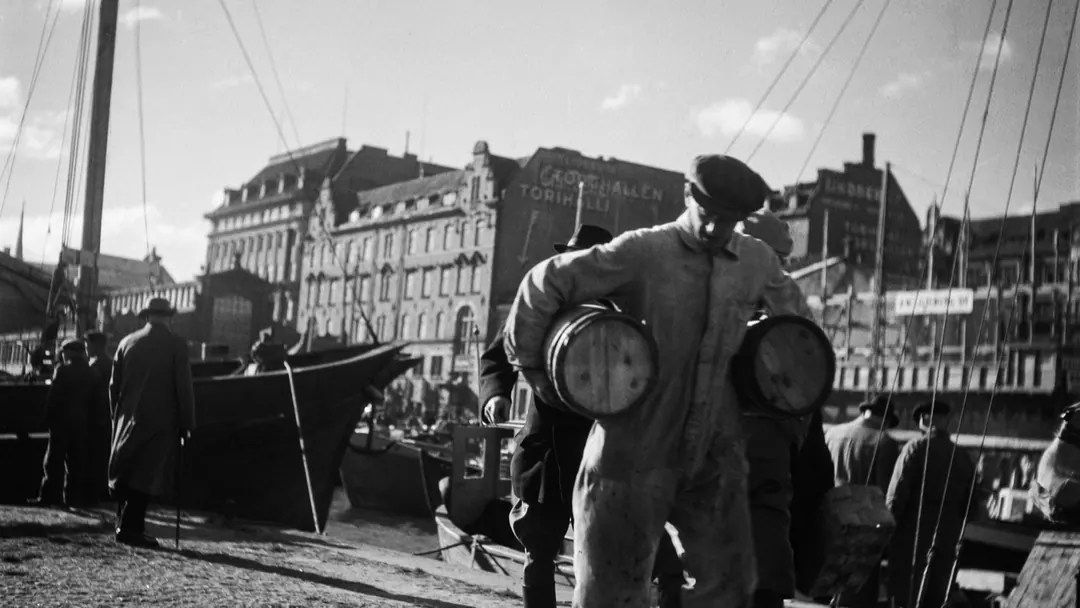
Nominative wins partly because it is the unmarked, dictionary-looking form. Subjects, predicate nouns and many plural objects land here.
Bussi tulee.
The bus is coming.
Nää on mun avaimet.
These are my keys.
Then comes the partitive. It marks, among other things, an unbounded quantity, an ongoing event's object and the object of a negative clause. Finnish grammar does not reduce it to one English preposition because the choice is bound up with quantity, aspect and negation.[^case-book]
Juon kahvia.
I'm drinking coffee.
En juo kahvia.
I don't drink coffee.
The genitive's -n does more than possession. It also supplies the form used for many total singular objects. Finnish object marking alternates between nominative-like, genitive-like and partitive forms; the authoritative grammar treats that alternation separately from the tiny set with a distinctive accusative ending.[^object]
## 4-8 and 10: the location machine

The six productive local cases form two three-step journeys.
| Where? | From where? | To where? |
|---|---|---|
| kaupassa, in the shop | kaupasta, from the shop | kauppaan, into the shop |
| pöydällä, on the table | pöydältä, off the table | pöydälle, onto the table |
In much southern colloquial Finnish, a final vowel may disappear: Mä oon kaupas, Mä tuun kaupast. These are widespread listening forms, not a rule for every dialect. The remaining -s versus -st still tells you location versus origin.
Adessive performs another ordinary trick:
Onks sulla aikaa?
Do you have time?
The Finnish possession pattern is built with the adessive: Onks sulla aikaa? literally places time "at you". That extra job helps explain why adessive outranks two members of its own location family.
## 9 and 11: being something, becoming something
Essive makes a role or state; translative marks a change or destination state. They sit next
to each other in the ranking because they answer the same question a beat apart: essive is
what something is while you are looking at it, translative is what it turned into.
English does the same work with prepositions, and often with nothing at all. That is why the
pair is easy to hear and hard to produce. "I work as a teacher" and "I qualified as a teacher"
use one English word for two different relationships. Finnish uses two endings.
| State | Change |
|---|---|
| Oon täällä töissä opettajana. - I work here as a teacher. | Valmistuin opettajaksi. - I qualified as a teacher. |
| Nähdään maanantaina. - See you on Monday. | Se muuttui punaiseksi. - It turned red. |
The translative also hides in a common deadline: Tuuks sä viideksi? asks "Will you come by five?" That one -ksi form turns up whenever somebody asks you to arrive by a particular time.
## 12-15: the restricted tail
Instructive occurs in expressions such as omin silmin, "with one's own eyes", and jalan, "on foot". Abessive appears in rahatta, "without money", but ordinary speech strongly favours ilman rahaa.
Comitative's zero means **the Arkisyn `mrp` values contained no `com` tag**, not that the form is imaginary. Hän tuli lapsineen means "They came with their children." Around a kitchen table, expect Se tuli lasten kaa. The descriptive grammar includes these restricted cases while showing why the borders of "the 15" are partly analytical.[^case-definition]
The accusative's rank is the bigger optical illusion. Finnish has objects everywhere; only a narrow pronoun set displays an unmistakable accusative form:
| Ordinary speech | Meaning |
|---|---|
| Se näki mut. | They saw me. |
| Mä näin sen. | I saw them/it. |
The corpus guide warns that parsed and annotated searches can contain analysis errors.[^guide] This table ranks **tags in one Arkisyn version**, not importance, difficulty or every conversation in Finland. The University of Turku describes its material as 29 hours across 26 texts; one conversation topic can move a low-frequency case noticeably.[^project]
## The useful order is not 1 through 15
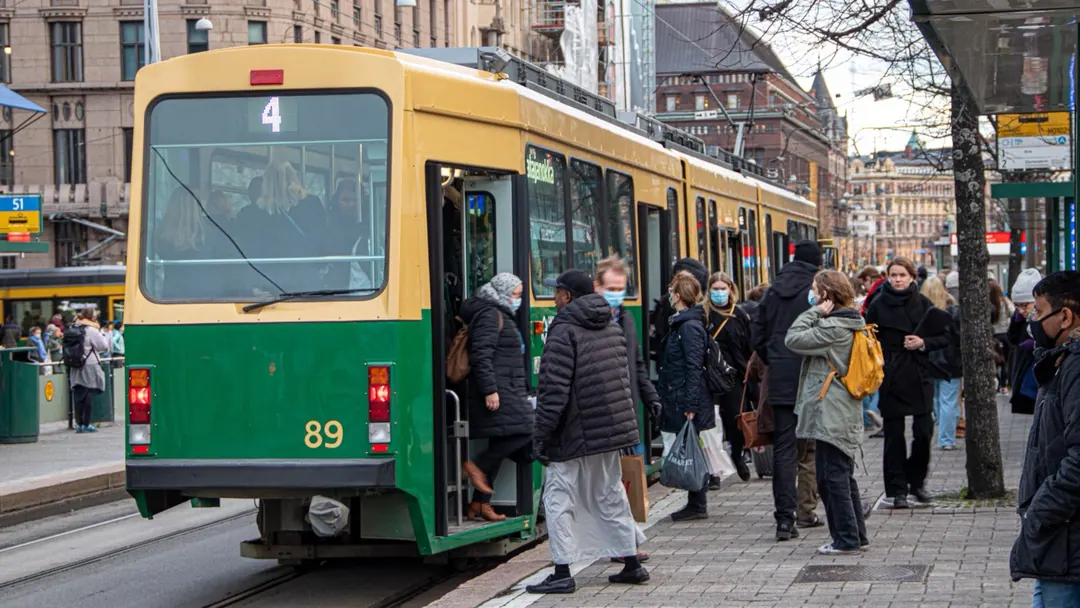
When speech is moving too fast to parse every ending, group the cases by what you need to notice:
1. **Hear now:** nominative, partitive and genitive - including their object jobs.
2. **Hear the route:** inessive, elative, illative, adessive, ablative and allative.
3. **Recognise on arrival:** essive and translative, then the restricted tail.
Do not postpone object case until rank 13. The dedicated accusative tag is rare precisely because most objects have already been counted under nominative, genitive or partitive.
[^arkisyn]: [Arkisyn](https://www.kielipankki.fi/corpora/arkisyn/), The Language Bank of Finland. Corpus scope and access.
[^project]: [ArkiSyn project and dataset details](https://www.utu.fi/en/university/faculty-of-humanities/school-of-languages-and-translation-studies/research/utu-digilang/arkisyn-database-of-finnish-conversational-discourse), University of Turku.
[^api]: [Korp API](https://www.kielipankki.fi/support/korpapi/), The Language Bank of Finland. Grouped corpus counts and attributes.
[^guide]: [Korp user guide](https://www.kielipankki.fi/support/korp/), The Language Bank of Finland. Annotation limitations.
[^case-definition]: [Iso suomen kielioppi §81](https://kaino.kotus.fi/visk/sisallys.php?p=81), Institute for the Languages of Finland. Case inventory and boundaries.
[^object]: [Iso suomen kielioppi §930](https://kaino.kotus.fi/visk/sisallys.php?p=930), Institute for the Languages of Finland. Object-case alternation.
[^case-book]: [The Finnish Case System: Cognitive Linguistic Perspectives](https://www.jstor.org/stable/jj.8816156), Finnish Literature Society.
FAQ:
Q: How many cases does Finnish have?
A: The conventional learner answer is 15. Analyses differ because Finnish object marking does not give every noun a unique accusative ending, and the three marginal cases are highly restricted.
Q: What is the most common Finnish case?
A: Nominative was first in our Arkisyn count with 63,286 tagged forms, 54.29% of the 15-case total.
Q: Which Finnish cases should a beginner learn first?
A: Prioritise nominative, partitive and genitive, then the six local cases as two matching families. Do not interpret that order as permission to ignore object case.
Q: Is the comitative used in spoken Finnish?
A: It is possible but restricted and normally carries a possessive suffix, as in lapsineen, 'with their children'. Ordinary speech usually uses kanssa, often shortened to kaa.
Q: Why is the accusative so rare in the ranking?
A: Most Finnish objects surface in forms identical to nominative, genitive or partitive. A distinct accusative ending is limited mainly to personal pronouns and kuka: minut, sinut, hänet and kenet.
Q: Are Finnish case endings shortened in speech?
A: Often, but not uniformly. In common southern colloquial Finnish, kaupassa and kaupasta may sound like kaupas and kaupast. Other regions and speakers preserve or reshape endings differently.
Q: Do the percentages add up to 100?
A: Yes, apart from rounding. The 116,569 denominator includes only tags containing the 15 case labels, not every token in the corpus.
Sources:
- Arkisyn: A morphosyntactically coded database of conversational Finnish: https://www.kielipankki.fi/corpora/arkisyn/
- ArkiSyn project and dataset details: https://www.utu.fi/en/university/faculty-of-humanities/school-of-languages-and-translation-studies/research/utu-digilang/arkisyn-database-of-finnish-conversational-discourse
- Korp API: https://www.kielipankki.fi/support/korpapi/
- Korp user guide: https://www.kielipankki.fi/support/korp/
- Sijamuodot: termin määrittely: https://kaino.kotus.fi/visk/sisallys.php?p=81
- Objektin sijanvaihtelu: https://kaino.kotus.fi/visk/sisallys.php?p=930
- The Finnish Case System: Cognitive Linguistic Perspectives: https://www.jstor.org/stable/jj.8816156