---
title: "24 Finnish questions your course never taught you"
description: "Courses teach Missä sinä asut? Real life asks Otaks sä kuitin?, Oliks sul Plussa-korttia? and Mitä sais olla? Here is the missing listening list."
type: "article"
category: "spoken-finnish"
url: "https://finnishirl.com/blog/finnish-questions-before-courses"
canonical: "https://finnishirl.com/blog/finnish-questions-before-courses"
published: "2026-10-01"
updated: "2026-10-01"
author: "Andrey the Nomad"
site: "Finnish IRL"
license: "https://finnishirl.com/terms#ip"
---
# 24 Finnish questions your course never taught you
URL: https://finnishirl.com/blog/finnish-questions-before-courses
Date: 2026-10-01
Updated: 2026-10-01
Category: spoken-finnish
Keywords: Finnish questions, spoken Finnish questions, common questions in Finnish, Finnish conversation phrases, puhekieli questions
Summary: Courses teach Missä sinä asut? Real life asks Otaks sä kuitin?, Oliks sul Plussa-korttia? and Mitä sais olla? Here is the missing listening list.
Quick answer:
- At a checkout, listen for Oliks sul Plussaa?, Otaks kuitin? and Pussiin? The missing words are supplied by the situation.
- At work, Mitä kuuluu? is often light contact; Ootsä menos syömään? may be an invitation, not a request for your calendar.
- Questions compress: oletko sinä becomes ootsä, onko becomes onks and haluatko becomes haluutsä or haluuks.
- Häh? is a repair request, not automatically rude, but Anteeks? and Mitä sä sanoit? are safer with strangers.
What you'll learn:
- Decode 24 questions in the places where they actually arrive
- Hear the question hiding inside ootsä, onks and haluuks
- Tell literal information requests from invitations and service routines
- Ask for a repeat without pretending you understood
Body:
You studied Missä sinä asut?. Then a cashier looked at you and said Oliks sul Plussaa?, and every word you knew apparently left the building.
The words are familiar after you expand them. Ootsä compresses oletko sinä, while the checkout supplies whatever the cashier leaves unsaid. Finnish grammar describes both interrogative-word questions and -ko/-kö questions; conversational corpora show what speakers actually do with them.[^visk][^arkisyn]
This is not a frequency chart. The 24 examples are an editorial listening list, not the 24 most frequent questions in Arkisyn. They form a checklist across six recurring scenes, because a grocery transaction and a family kitchen do not produce the same questions.
## The checkout ambush
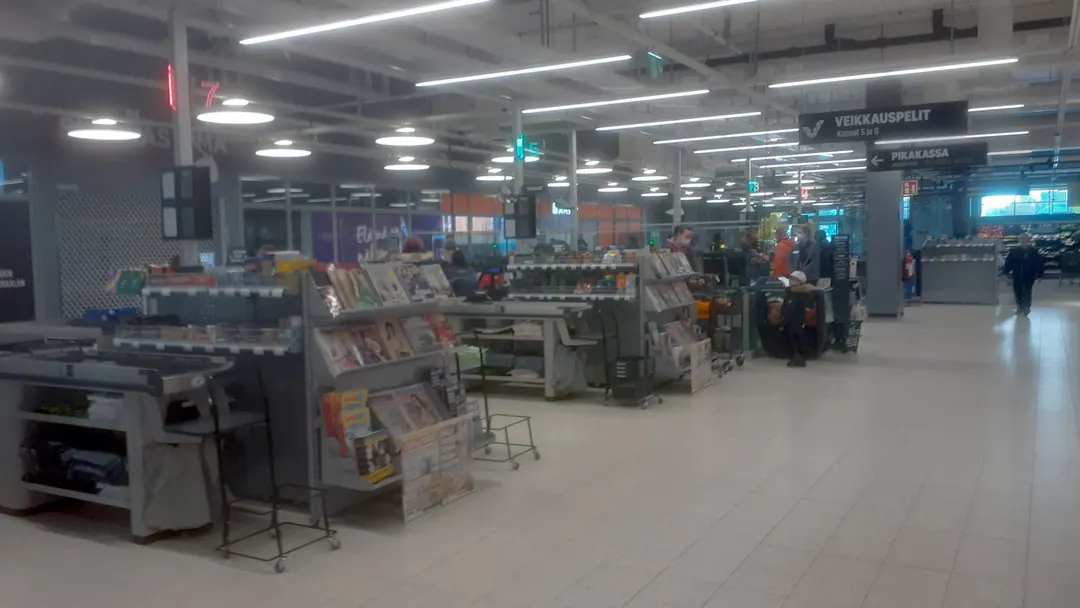
### 1. Oliks sul Plussaa?
Despite the past form oliks, the cashier is asking whether you have Plussa benefits for this purchase.
### 2. Otaks sä kuitin?
"Will you take the receipt?" Reply Joo, kiitos or Ei kiitos.
### 3. Pussiin?
"In a bag?" One word, one rising contour, a whole proposition supplied by the checkout.
### 4. Meniks oikein?
"Did it go through correctly?" You may hear this after a discount, return or payment wobble.
Oliks sul Plussaa?
Do you have a Plussa card?
Ei oo.
No.
Otaks kuitin?
Receipt?
En tarvii, kiitos.
I don't need it, thanks.
## The café lines that are not in the menu
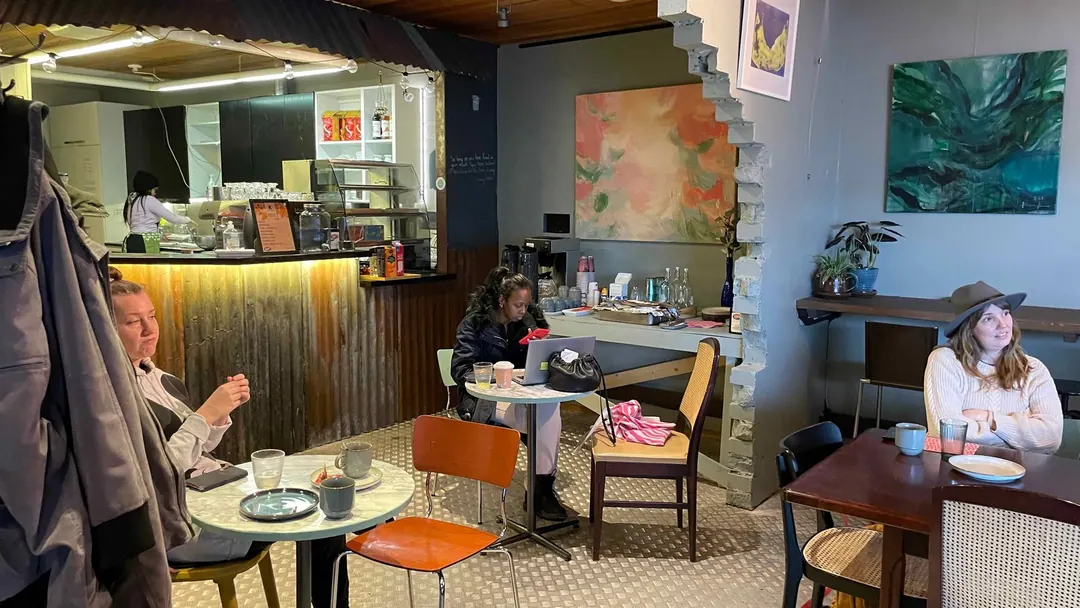
### 5. Mitä sais olla?
Literally "what might there be?", functionally "what can I get you?" Answer with the order, not a philosophical account of possibility.
### 6. Tuleeks maitoo?
"Will there be milk?" In smoother English: "Milk?" Tulee and Ei tuu work as answers.
### 7. Täällä vai mukaan?
"For here or takeaway?" The verb is absent because nobody needs it.
### 8. Muuta?
"Anything else?" The useful answer is Ei muuta.
## The office questions with a second job
### 9. Mitä kuuluu?
Usually light contact, not a demand for your complete emotional status. Ihan hyvää is enough.
### 10. Ootsä menos syömään?
"Are you going to eat?" can be a lunch invitation wearing an information-question costume.
### 11. Meinaaksä tulla palaveriin?
"Are you planning to come to the meeting?" Depending on tone, this can mean "we are waiting".
### 12. Eiks tää ollu huomiselle?
"Wasn't this for tomorrow?" The negative question displays an expectation. A bare joo can be treacherous across languages; answer the proposition clearly: Joo, huomiselle or Ei, tälle päivälle.[^responses]
## Doorways, lifts and shared space
### 13. Ootsä jäämäs tässä?
"Are you getting off here?" Heard when you are blocking an exit with excellent intentions.
### 14. Mahtuuks siitä?
"Can you get through there?" or "Is there room?" Move first; parse later.
### 15. Onks tää vapaa?
"Is this free?" It may concern a seat, hook, machine or table.
### 16. Oliks tää sun?
"Was this yours?" The object is usually being held up as evidence.
## Invitations that do not announce themselves
### 17. Tuutsä kahville?
"Are you coming for coffee?" The everyday invitation is often this plain.
### 18. Lähetäänks?
"Shall we go?" The passive-looking spoken form does collective work: you and me.
### 19. Otaks vielä?
"Will you have some more?" At a table, the missing object is visible or already topical.
### 20. Jäätkö yöks?
"Are you staying the night?" Here yöks is spoken yöksi, not the written interjection yöks!, "yuck". Context rescues everybody.
## The four questions that repair the conversation
In 37.5 hours of Finnish everyday conversation, researchers found 522 linguistic repair initiations. Open question words, repeats and candidate understandings were all recurrent solutions.[^repair] Missing something is not conversational failure; speakers have machinery for it.
### 21. Häh?
"What?" Efficient with friends. Use Anteeks? when you want a softer edge.
### 22. Kuka?
"Who?" Repeat the slot you missed rather than requesting the whole performance again.
### 23. Siis mihin aikaan?
"So, at what time?" Siis flags that you are reformulating or pinning down the prior talk.
### 24. Tarkotaksä että…?
"Do you mean that…?" This offers your candidate understanding:
Tarkotaksä, että se on peruttu?
Do you mean it has been cancelled?
Ei ku se siirrettiin.
No, it was moved.
That ei ku is another piece courses under-teach: "no, rather…" The correction arrives before the polished sentence.
## Three contractions worth hearing as shapes
| Course form {fi} | Likely spoken shape {fi} | Example {fi} |
|---|---|---|
| Oletko sinä…? | Ootsä…? | Ootsä tulossa? |
| Onko…? | Onks…? | Onks tää sun? |
| Haluatko sinä…? | Haluutsä…? / Haluuks…? | Haluuks kahvii? |
These are broad colloquial forms, not rules imposed on every region. Spoken and written Finnish are internally varied, and written dialogue only approximates sound.[^speech-writing]
At the checkout, catch Plussaa, kuitin or pussiin first. At work, catch syömään, palaveriin or huomiselle. The room often identifies the missing half of the question.
[^arkisyn]: [ArkiSyn](https://www.kielipankki.fi/corpora/arkisyn/) contains morphologically and syntactically annotated everyday Finnish conversations from Helsinki and Turku archives.
[^repair]: [Kuka, mitä, häh?](https://journal.fi/virittaja/article/view/51319), Virittäjä 2/2016, analyses 522 repair initiations in 37.5 hours of adult native-speaker conversations.
[^visk]: [VISK §888](https://kaino.kotus.fi/visk/sisallys.php?p=888) describes Finnish interrogative clause types; [§1200](https://kaino.kotus.fi/visk/sisallys.php?p=1200) treats questions as conversational actions.
[^responses]: Marja-Leena Sorjonen's [Responding in Conversation](https://benjamins.com/catalog/pbns.70) analyses Finnish niin and joo across answers, directives and extended tellings.
[^speech-writing]: Kotus, [Ovatko puhuttu ja kirjoitettu kieli erkaantuneet toisistaan?](https://kotus.fi/kolumni/ovatko-puhuttu-ja-kirjoitettu-kieli-erkaantuneet-toisistaan/), stresses variation inside both speech and writing.
FAQ:
Q: How do Finns ask yes-or-no questions?
A: Standard Finnish adds -ko/-kö to the focused word: Tuletko? In ordinary speech, Tuutsä? and Tuuks? are common contractions.
Q: What does ootsä mean?
A: It is spoken oletko sinä: are you? Ootsä tulossa? means are you coming?
Q: What does onks mean?
A: It is spoken onko: is there, is it or does someone have, depending on what follows.
Q: Is häh rude?
A: Among familiar speakers it is a normal open repair request, roughly what? With a stranger, Anteeks? is gentler.
Q: Why do Finnish questions omit words?
A: Shared surroundings make them recoverable. Pussiin? at a checkout means shall I put it in a bag? without saying any of that.
Q: How do I ask someone to repeat in Finnish?
A: Say Anteeks? or Mitä sä sanoit? You can also identify the missing part: Mihin aikaan?
Q: Does every spoken-Finnish question sound the same across Finland?
A: No. These are widely intelligible urban colloquial forms, not a map of every dialect.
Sources:
- ArkiSyn Database of Finnish Conversational Discourse: https://www.kielipankki.fi/corpora/arkisyn/
- Kuka, mitä, häh?: https://journal.fi/virittaja/article/view/51319
- Interrogative clauses: https://kaino.kotus.fi/visk/sisallys.php?p=888
- Questions and answers: https://kaino.kotus.fi/visk/sisallys.php?p=1200
- Responding in Conversation: https://benjamins.com/catalog/pbns.70
- Ovatko puhuttu ja kirjoitettu kieli erkaantuneet?: https://kotus.fi/kolumni/ovatko-puhuttu-ja-kirjoitettu-kieli-erkaantuneet-toisistaan/
- Why-interrogatives in conversation: https://academic.oup.com/joc/article/61/1/94/4098559
Related words: eiku