---
title: "Does Finnish have 40 words for snow? Not quite"
description: "Finnish can name snow with remarkable precision, but famous lists mix snow, slush, frost, weather and easy compounds. Here is how the count cheats."
type: "article"
category: "finland-explained"
url: "https://finnishirl.com/blog/finnish-words-for-snow"
canonical: "https://finnishirl.com/blog/finnish-words-for-snow"
published: "2026-10-01"
updated: "2026-10-01"
author: "Andrey the Nomad"
site: "Finnish IRL"
license: "https://finnishirl.com/terms#ip"
---
# Does Finnish have 40 words for snow? Not quite
URL: https://finnishirl.com/blog/finnish-words-for-snow
Date: 2026-10-01
Updated: 2026-10-01
Category: finland-explained
Keywords: Finnish words for snow, Finnish snow words, how many words for snow in Finnish, Finnish word for snow, lumi meaning, hanki nuoska loska
Summary: Finnish can name snow with remarkable precision, but famous lists mix snow, slush, frost, weather and easy compounds. Here is how the count cheats.
Quick answer:
- There is no defensible fixed total. Finnish has independent snow terms and transparent compounds with lumi, so the number changes with the counting rules.
- Lumi is snow generally; hanki is snow lying on the ground, nuoska is wet packable snow and loska is melting slush underfoot.
- Räntä falls from the sky, loska lies on the ground, and tykky weighs down trees. Viral graphics often flatten them into synonyms.
- The useful fact is not 40: Finnish sorts winter conditions by location, behaviour and what people can do on the surface.
What you'll learn:
- How to spot the counting tricks inside a viral snow-word graphic
- Which winter terms unlock an actual forecast or pavement conversation
- Why lumi becomes lunta in the sentence heard most often
- Which picturesque entries are technical, marked or merely compounds
Body:
The internet's favourite Finnish snow graphic arrives with a confident number and a suspiciously generous definition of snow. One version reaches 40 by admitting frost, sleet, a snowstorm, a snowball and compounds as transparent as English "powder snow."
Our verdict: **40 is possible as a list length, not meaningful as a linguistic fact.** Finnish has useful distinctions that English often phrases differently. It also builds compounds productively, so the counter need not stop when the graphic does.
## Twelve famous entries, four different games
| Word {fi} | What it names | Verdict |
| --- | --- | --- |
| lumi | snow, the general substance | core word |
| hanki | an expanse of snow on the ground | distinct and useful |
| nuoska | moist, sticky, packable snow | distinct and useful |
| loska | watery, melting slush on the ground | snow-related state |
| räntä | partly melted precipitation falling | precipitation |
| pyry | heavy snowfall; sometimes a snowstorm | weather event |
| tuisku | blowing or drifting snowfall | weather event |
| kinos | a drift or bank of snow | shape made by snow |
| nietos | a literary or regional word for a snowdrift | not neutral everyday vocabulary for all speakers |
| tykky | heavy snow/rime accumulation on trees | attached load |
| kuura | frost deposited on surfaces | ice, not snow |
| puuterilumi | powder snow | transparent compound |
The vocabulary is real. The common denominator is not.
The Finnish Meteorological Institute draws a practical line: moist snowflakes are nuoska; when drops occur among partly melted flakes, precipitation is räntä; melting snow on the ground is loska.[^precipitation] Räntä hits your coat, nuoska packs into a snowball, and loska soaks your shoes.
The viral-number test
Ask whether compounds, dialect words, inflected forms, ice and storms count. If the list never says, its number cannot be checked.
## The six words your boots understand first
### 1. Lumi: the ordinary one with a trapdoor
Lumi is an ancient inherited word with cognates across Uralic languages.[^lumi] Yet December conversations often contain lunta, its partitive form.
Sataa lunta.
It is snowing.
Tänä vuonna on vähän lunta.
There is little snow this year.
Lumi suli jo pois.
The snow has already melted away.
Do not count lumi and lunta separately. That is one noun doing Finnish grammar.
### 2. Hanki: snow after it owns the landscape
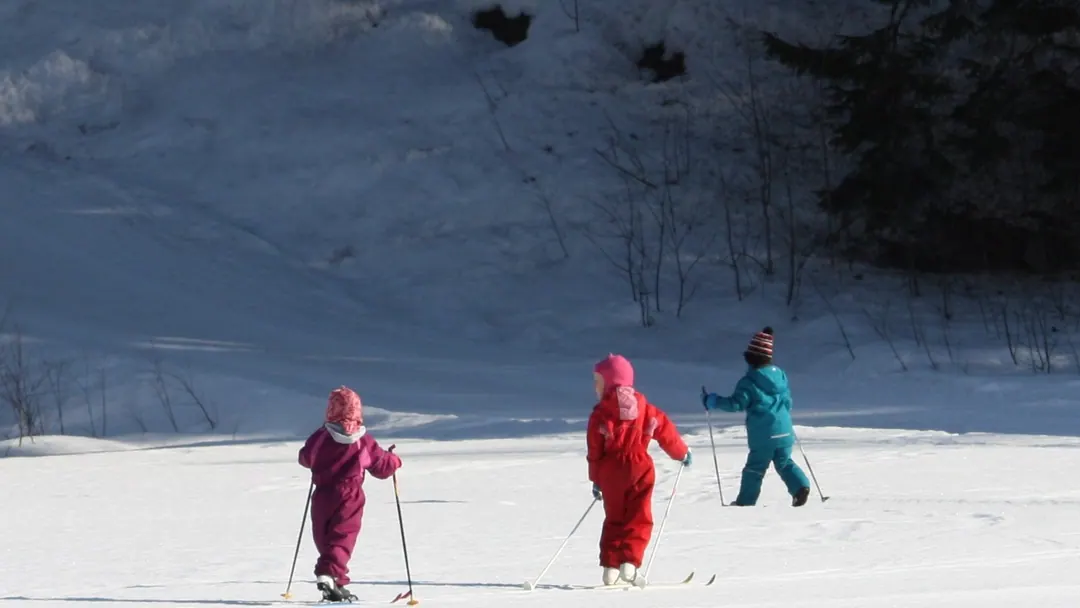
Hanki is snow cover experienced as a surface or expanse. Hankikanto means that the snow cover, or its hardened surface, can bear a person's weight, typically after thaw-freeze conditions.[^hankikanto]
Lapset juoksivat hangessa.
The children ran in the deep snow.
Aamulla hanki kantoi.
In the morning, the snow crust held our weight.
### 3. Nuoska: snowman weather
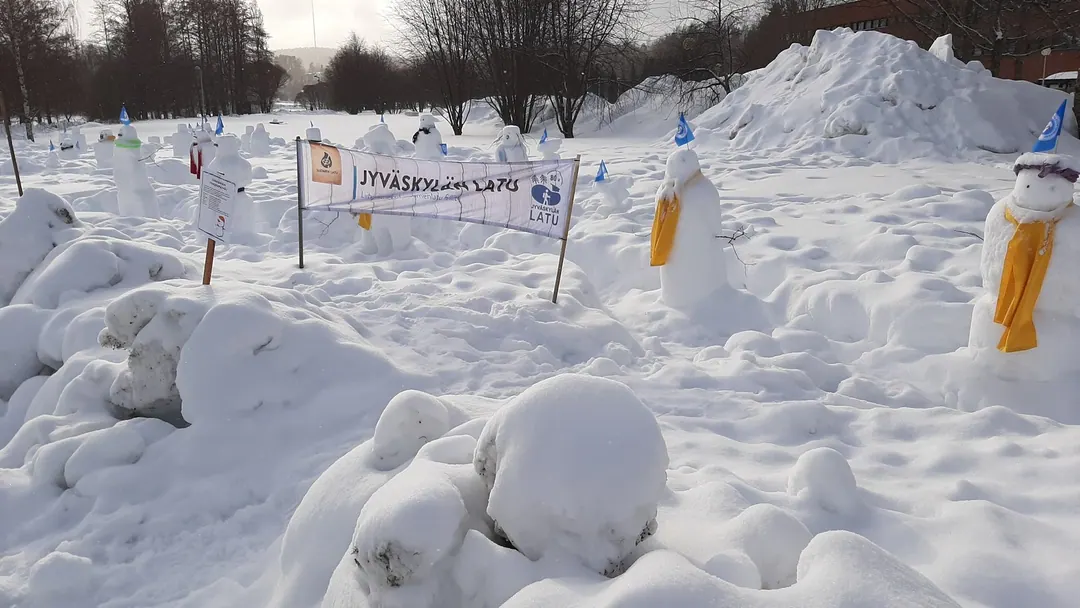
Nuoska sticks. It squeezes into a ball rather than exploding into powder.
Nyt on hyvä nuoskakeli.
It is good sticky-snow weather now.
Lumi on ihan nuoskaa.
The snow is really wet and packable.
### 4. Loska: the grey sequel
Kadut on ihan loskassa.
The streets are completely slushy.
Bussi roiskutti loskaa mun päälle.
The bus splashed slush all over me.
### 5. Kinos: the pile the wind built
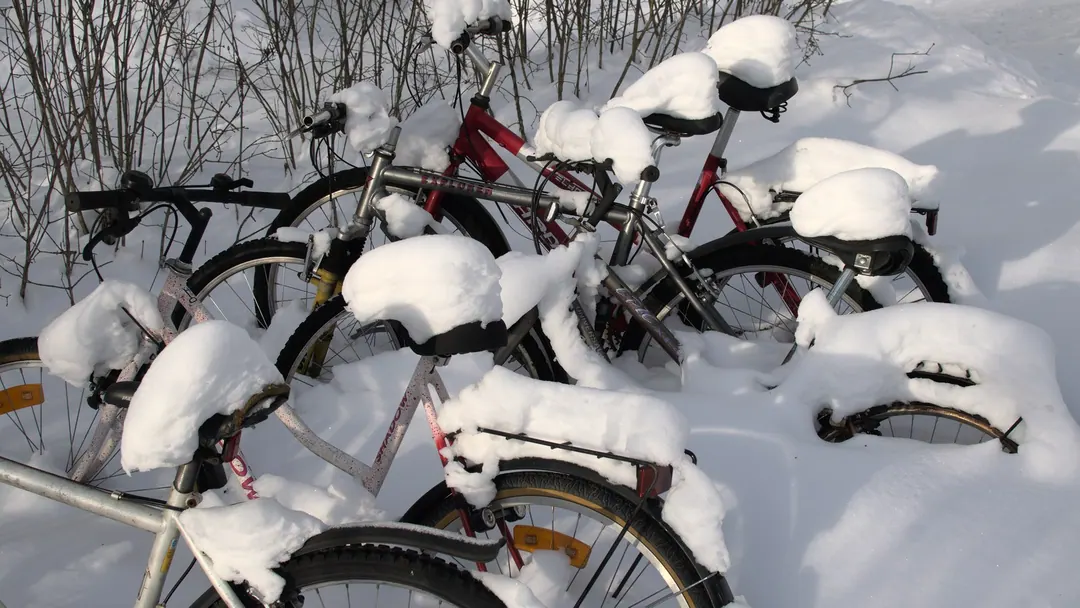
A kinos tells you the snow's shape, not its crystal type: Auto jäi kiinni kinokseen, "The car got stuck in a drift."
### 6. Tykky: the one that bends forests
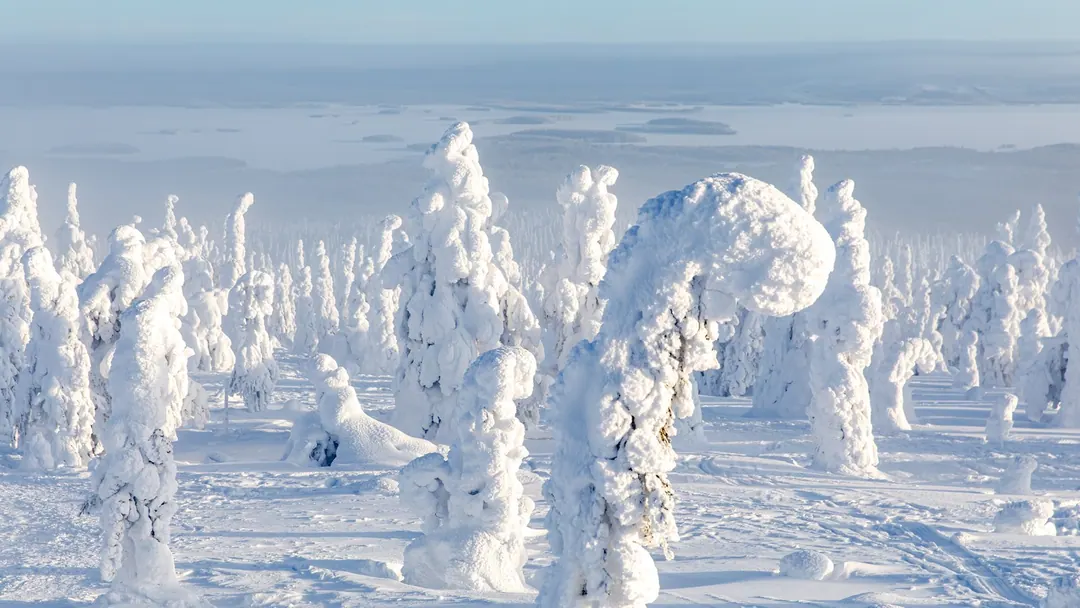
Tykky is heavy accumulation on tree crowns. The Meteorological Institute distinguishes huurretykky and nuoskatykky; these loads can break trees and disrupt electricity.[^tykky] Counting all four related labels as four independent proofs of uniqueness would still be cheeky.
## How the list reaches 40
Kotus notes compounds including höytylumi, nuoskalumi, pyrylumi, sohjolumi and tykkylumi.[^full] Finnish closes the spaces, making familiar combinations look exotic.
| Compound {fi} | Plain construction |
| --- | --- |
| ensilumi | first snow |
| pakkaslumi | dry snow in frost |
| puuterilumi | powder snow |
| kevätlumi | spring snow |
| lumipallo | snowball |
| lumimyrsky | snowstorm |
| lumilinko | snow blower |
The last three contain snow but do not denote types of it. English also has snowfall, snowbank, snowpack, snowdrift and snowflake. Spaces do not make English conceptually poorer.
This is the mechanism behind every high number you have seen. Finnish compounds by writing the
parts together, so any pairing a speaker invents on the spot arrives looking like a dictionary
entry, and a list can be extended for as long as the person making it keeps going. English
counts the same idea as two words and does not put it on the list.
An honest count stops where the compounds stop adding information. A defensible list holds
the words whose meaning the parts do not give you: the ones a Finn reaches for to say what the
morning is actually like, and that "snow" plus an adjective would not replace.
## Three meme claims, rated
**"Exactly 40 words." Unsupported.** The cited Finnish language and weather authorities do not publish a closed 40-word inventory, and productive compounds give it fuzzy edges.
**"Every word is falling snow." False.** Räntä falls, loska splashes underfoot, kinos has accumulated and tykky clings to trees.
**"English speakers cannot perceive the distinctions." False.** English has powder, crust, slush, sleet and drift. Yle made the same point when examining the famous "Eskimo snow" story.[^yle] Linguists traced how that story grew from a small observation into poorly defined numbers.[^hoax] Finnish is not Inuit or Yupik, and Sámi is not Finnish.
The genuine story is strong enough. Finland's weather service defines permanent snow cover operationally, and typical cover lasts more than half the year in Lapland.[^statistics] People need to know whether a surface bears weight, precipitation soaks clothing or trees carry a dangerous load. Keep the vocabulary; lose the magic number.
[^lumi]: [Lumi](https://kotus.fi/sana/lumi/), Institute for the Languages of Finland.
[^full]: [Lunta tulvillaan](https://kotus.fi/lunta-tulvillaan/), Institute for the Languages of Finland.
[^precipitation]: [Sateen olomuodot](https://www.ilmatieteenlaitos.fi/sateen-olomuodot), Finnish Meteorological Institute.
[^tykky]: [Tykky eli tykkylumi](https://www.ilmatieteenlaitos.fi/tykky-eli-tykkylumi), Finnish Meteorological Institute.
[^hankikanto]: [Hankikanto Lapissa](https://www.luontoon.fi/fi/artikkelit/kuvatunnelmia-luonnosta-hankikanto-lapissa), Metsähallitus.
[^statistics]: [Snow statistics](https://en.ilmatieteenlaitos.fi/snow-statistics), Finnish Meteorological Institute.
[^yle]: [Eteenpäin, sanoi eskimo lumessa](https://yle.fi/aihe/a/20-67695), Yle.
[^hoax]: [The Great Eskimo Vocabulary Hoax](https://www.degruyter.com/document/doi/10.7208/9780226685368/html), University of Chicago Press.
FAQ:
Q: Does Finnish have 40 words for snow?
A: Finnish easily supplies 40 snow-related entries if compounds and nearby concepts count. There is no authoritative fixed total because transparent compounds can be formed productively.
Q: What is the basic Finnish word for snow?
A: Lumi is the basic noun. Weather sentences often use its partitive lunta, as in Sataa lunta, 'It is snowing.'
Q: What is the difference between nuoska and loska?
A: Nuoska is moist, sticky snow. Loska is snow that has melted into watery slush on the ground.
Q: Is räntä snow?
A: Räntä is partly melted or mixed winter precipitation. It is snow-related, but not simply another synonym for snow.
Q: What is hanki in English?
A: Hanki is a substantial layer or expanse of snow on the ground. English may need snow cover, snowfield or simply snow.
Q: What does tykky mean?
A: Tykky is a heavy accumulation attached to tree crowns and branches. It may include snow, rime and ice crystals.
Q: Do Sámi languages have many snow words?
A: Sámi snow terminology is richly documented, but Sámi is not Finnish and is not one uniform language. It cannot prove a Finnish word count.
Q: Why can nobody give an exact count?
A: The result depends on whether compounds, dialect words, inflected forms, ice and weather events are admitted. Without those rules, a total says little.
Sources:
- Lumi: https://kotus.fi/sana/lumi/
- Lunta tulvillaan: https://kotus.fi/lunta-tulvillaan/
- Sateen olomuodot: https://www.ilmatieteenlaitos.fi/sateen-olomuodot
- Tykky eli tykkylumi: https://www.ilmatieteenlaitos.fi/tykky-eli-tykkylumi
- Snow statistics: https://en.ilmatieteenlaitos.fi/snow-statistics
- Hankikanto Lapissa: https://www.luontoon.fi/fi/artikkelit/kuvatunnelmia-luonnosta-hankikanto-lapissa
- Eteenpäin, sanoi eskimo lumessa: https://yle.fi/aihe/a/20-67695
- The Great Eskimo Vocabulary Hoax: https://www.degruyter.com/document/doi/10.7208/9780226685368/html