---
title: "Spoken Finnish eats the endings that carry grammar"
description: "Five of the regular changes between written and spoken Finnish wear down the end of the word. That is where Finnish keeps person, number and possession."
type: "article"
category: "spoken-finnish"
url: "https://finnishirl.com/blog/spoken-vs-written-finnish"
canonical: "https://finnishirl.com/blog/spoken-vs-written-finnish"
published: "2026-10-01"
updated: "2026-10-01"
author: "Andrey the Nomad"
site: "Finnish IRL"
license: "https://finnishirl.com/terms#ip"
---
# Spoken Finnish eats the endings that carry grammar
URL: https://finnishirl.com/blog/spoken-vs-written-finnish
Date: 2026-10-01
Updated: 2026-10-01
Category: spoken-finnish
Keywords: spoken finnish vs written finnish, why cant i understand spoken finnish, puhekieli, kirjakieli, colloquial finnish, finnish spoken language
Summary: Five of the regular changes between written and spoken Finnish wear down the end of the word. That is where Finnish keeps person, number and possession.
Quick answer:
- Written Finnish and spoken Finnish differ by about twelve regular changes. Twelve is our count rather than a standard one, and most of them can be undone by rule.
- Five of them wear down the end of the word, which is where Finnish keeps person, number, possession and questionhood. Case survives every one of them.
- Four are substitutions and no rule reverses those: the pronouns, han and he, the demonstratives, and the passive standing in for we. A closed set of about twenty forms.
- Nothing you were taught was wasted. The case endings survive all of it, so the written form you know is still the thing you are matching against.
What you'll learn:
- Why the classroom sounds nothing like the corridor, in numbers from 1994
- Which changes you can undo on a word you have never met, and the four you simply have to know
- What to listen for when the ending you were trained to parse is not there
- Why the case endings you drilled survive every one of the changes
Body:
In the early 1990s Marja-Terttu Storhammar recorded four Finnish teachers of Finnish, each speaking to three different audiences: beginners, continuing students, and other Finns. She counted how often the standard forms minä and sinä came out rather than the spoken mä and sä.
To the beginners: between 83 and 100 per cent of the time. To Finnish speakers: between nought and seven.[^percentages] The same four people, the same week. Me menemme ran to 100 per cent with the foreign students and between nought and twelve with Finns.
Nobody was misleading anybody. The teachers were doing the sensible thing, and it has a name in the paper: they were speaking yleiskieli, the standard, because that is what a simplified Finnish is understood to be.[^storhammar]
## The register you were taught is a real thing, and it is not the default
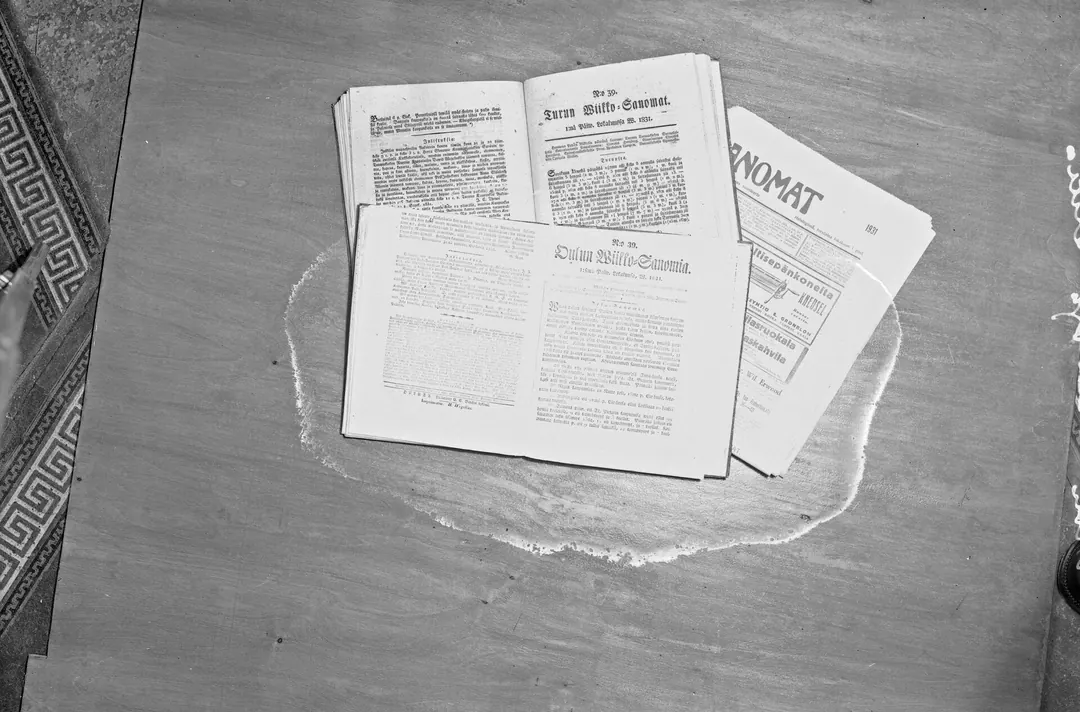
Written Finnish was assembled on purpose. Its combination of features belongs to no single source dialect, and the argument that settled which features went in ran for decades.[^kielikello]
Storhammar's conclusion about the world outside the classroom points one way only: it is extremely likely that foreigners hear a great deal of colloquial forms out there, and the careful standard they may hear, put sharply, only as speech read aloud on radio and television.[^storhammar] She also passes on a stronger suspicion, attributing it to Karlsson: that a fully-formed spoken standard is a construct, realised in nobody's speech and in no speech situation.
That is a doubt reported, not a finding. What is measured is that the standard is a **register**, not a class marker. In a televised debate before the 1999 election, nearly 40 per cent of Esko Aho's first-person pronouns were mä, while Paavo Lipponen and Sauli Niinistö used forms departing from the standard barely at all. In a presidential debate the following year the same Esko Aho was the more standard of the two speakers on the stage - a ranking rather than his own rate, so read it as a man whose position on the scale moves with the room.[^nuolijarvi]
One man, two rooms, two positions on the same scale. **The person talking to you is not speaking badly. They have selected a register, and it is the one nearly everyone selects when nobody is reading.**
## Where the changes land
**Five of the changes wear down the end of the word, and that is where Finnish keeps person, number, possession and questionhood. Three more land inside the word and touch no grammar at all.**
English contractions eat function words: *do not*, *I am*, *we will*. Finnish eats those too, and then it eats the inflection as well, which English has almost none of to lose. A learner trained to parse Finnish by reading its endings has been trained on the part of the word that goes first.
Case survives all of it. Mun auto, sulla, kauppaan keep their case endings exactly as written Finnish does, which is why the written form you know is still the thing you are matching against.
| Kind | How many | Can you undo it |
| --- | --- | --- |
| An ending erodes | five | yes, by rule, on a word you have never met |
| A sound changes inside the word | three | yes, and no grammar is involved |
| One word is substituted for another | four | no. You have to know them |
## The five that erode an ending
| Written {fi} | Spoken {fi} |
| --- | --- |
| Onko sinulla aikaa? | Onks sulla aikaa? |
| minun autoni | mun auto |
| He ovat tulleet | Ne on tullu |
| He menevät kotiin | Ne menee kotiin |
| mutta, että, vielä | mut, et, viel |
- **The question ending shrinks to a single -ks welded to the verb**, or goes entirely, and the word order and the situation carry the question.
- **Possessive suffixes go and the pronoun does the work.** Minun autoni to [mun auto](/words/mun).
- **Plural agreement collapses into the singular.** He menevät to ne menee, ovat to on. The verb simply stops agreeing.
- **The past participle loses its final -t**, after dropping to the singular first: tulleet to tullut to tullu. So He ovat tulleet is three changes in three words.
- **Short function words lose their final vowel.** Mutta to mut, että to et, vielä to viel, kyllä to kyl. Clipped, not replaced, so the written form is one vowel away. Watch et: it is also the negative verb for *you*, so et tuu is "you are not coming" and mä sanoin et is "I said that".
Notice the trade in the second row. Written Finnish keeps the ending and drops the pronoun; spoken Finnish drops the ending and puts the pronoun back. The information does not go anywhere. It moves.
And underneath most of this, unmoved: vowel harmony. Front-vowel stems keep taking -ä, -ö, -y and back-vowel stems keep taking -a, -o, -u, in the contracted forms exactly as in the full ones: mennään and ollaan, tehdään and syödään. The one place it gives way is on this list. Written -ko/-kö harmonises; spoken -ks does not. Onks, saaks, heitänks, mennäänks - one form for all of them.
## The three that happen inside the word
No grammar is involved in any of these. They are sound changes, and they are the reason a word you know arrives sounding like one you do not.
- **Four verbs contract when a consonant drops between two vowels.** Olen to [oon](/words/oon), tulen to tuun, menen to [meen](/words/meen). The word gets shorter and [the vowel gets longer](/blog/finnish-pronunciation-length). Panen to paan goes the same way and is a word to be careful with. **This one is four verbs, not a rule** - sanon does not become saon and kuulen does not become kuun.
- **The i drops out of diphthongs in unstressed syllables.** Punainen to [punanen](/words/punanen), kirjoittaa to kirjottaa. Whole families of adjectives at once, though longer words hold on harder: suomalainen keeps its i far more often than punainen does.
- **Ts flattens to t, and ole loses its l.** Katsotaan to [katotaan](/words/katotaan), katson to katon. Ei ole to [ei oo](/words/ei-oo), en ole to en oo.
## The four you have to know
These are substitutions. The word is exchanged for a different one, so no rule takes you back.
- **The personal pronouns.** Minä to [mä](/words/ma), sinä to [sä](/words/sa). In the southeast and the far north, mie and sie; in the southwest and around Tampere, mää and sää.
- **Hän becomes [se](/words/se), and he becomes [ne](/words/ne).** People are referred to with the same word as things, and there is nothing rude in it.
- **The demonstratives.** Tämä to tää, tuo to toi, nämä to nää, nuo to noi, and they inflect from the short stem: tämän is tän. Finnish has no articles, so these do the pointing work in nearly every sentence.
- **The passive replaces the first person plural.** Menemme to [mennään](/words/mennaan), teemme to tehdään. A whole construction exchanged for another, and me mennään needs its me, because the passive marks no person at all.
A few phrases are simply frozen and have to be learned as they are: en tiedä to [en tiiä](/words/en-tiia), niin kuin to [niinku](/words/niinku).
**Learn the substitutions first, because they are the only part you cannot derive.** They are a closed set of roughly twenty forms, and they are in nearly every sentence. The eight erosions and sound changes you can undo on the fly, on a word you meet for the first time.
## What this changes about listening
**Hold the stem and restore the ending.**
You are not hearing an unfamiliar word. You are hearing a familiar one with its ending sanded off, and the written form you learned is the thing you are matching against. That is why none of it was wasted. Reading a Kela letter and following a corridor conversation are the same vocabulary at two different lengths.
The pairs themselves are collected on [the puhekieli page](/puhekieli): the written form, the spoken form and the change between them, for every word on this site.
Two practical consequences.
**Read chat, not articles.** Finnish in messages and comment threads is written in the spoken forms - mä, oon, niinku, the endings already gone - and it holds still while you work them out.
**Expect the standard forms to mark you.** This is the uncomfortable one. Research in multi-ethnic Helsinki schools found that minä and sinä have picked up an indexicality tied to learner language and to foreignness: they are over-represented in the teaching register compared with other speech, and using the standard in conversation is itself now unusual enough to mark a speaker as an outsider.[^lehtonen] The textbook pronoun is audible.
There is a smaller version of this buried inside a very large project. When Aalto and the University of Helsinki collected 3,600 hours of ordinary spoken Finnish from more than twenty thousand donors, they paid professional transcribers to write down exactly what was said. One of them kept failing the check in a specific way: they had transcribed the files mostly correctly, but often used the formally correct spelling instead of writing the verbatim spoken version.[^lahjoita] It is a note from a quality check rather than a statistic.
A native Finn, hired to type what they heard, kept typing the written form instead.

[^percentages]: [Tyylitellen, p. 215](https://helda.helsinki.fi/server/api/core/bitstreams/383a191e-8277-4c89-9a28-a41591fd0cde/content) - Heini Lehtonen, University of Helsinki, 2015, stating in prose the figures Storhammar presents as Kuvio 1 and Kuvio 2
[^storhammar]: [Puhekielen asema ulkomaalaisopetuksessa, pp. 101 and 104](https://www.kotikielenseura.fi/virittaja/hakemistot/jutut/1994_97.pdf) - Marja-Terttu Storhammar, Virittäjä 98(1), 1994, pp. 97-109. The Karlsson attribution is hers, at p. 101
[^kielikello]: [Murre ja yleiskieli, Kielikello 2/1986](https://kielikello.fi/murre-ja-yleiskieli/) - Tuomo Tuomi, Kotimaisten kielten keskus
[^nuolijarvi]: [Puhutun kielen variaatio televisiokeskustelussa, pp. 375 and 382](https://www.kotikielenseura.fi/virittaja/hakemistot/jutut/2003_370.pdf) - Pirkko Nuolijärvi, Virittäjä 107(3), 2003
[^lehtonen]: [Tyylitellen, pp. 214-217](https://helda.helsinki.fi/server/api/core/bitstreams/383a191e-8277-4c89-9a28-a41591fd0cde/content) - Heini Lehtonen, University of Helsinki, 2015
[^lahjoita]: [Lahjoita puhetta: a large-scale corpus of spoken Finnish](https://arxiv.org/abs/2203.12906) - Moisio, Porjazovski, Rouhe et al., Aalto University and University of Helsinki. The transcriber note is in the annotation section
FAQ:
Q: Is puhekieli the same as slang?
A: No. Slang is vocabulary, and it varies by group and by decade. Puhekieli is a register with regular grammatical rules, used by nearly everyone in nearly every unscripted situation, including by people speaking carefully.
Q: Do Finns write in puhekieli?
A: Constantly, in messages, comments and chat.
Q: Will Finns understand me if I speak kirjakieli?
A: As Finnish, yes. It will sound careful and slightly bookish rather than wrong. What can still fail is your accent rather than your register, which is a different problem. The register problem runs the other way: you understanding them.
Q: Is puhekieli lazy or uneducated Finnish?
A: No, and the measurement that shows it is about one speaker rather than a group. Esko Aho used mä for nearly 40 per cent of his first-person pronouns in a 1999 televised election debate, and in a presidential debate the following year he was the more standard speaker on the stage. It is a register selected for the room, not a level somebody is stuck at.
Q: Does everyone speak the same puhekieli?
A: No. There is a widely shared spoken standard built on the southern forms, and regional forms on top of it: mä and sä in the south and as the general spoken standard, mie and sie in the southeast and in the far north, mää and sää in the southwest and around Tampere.
Q: Why do textbooks not teach this?
A: The classroom register is deliberate. Research on teachers of Finnish as a foreign language found they used the standard forms to foreign students almost invariably, and the same teachers used the spoken forms with other Finns.
Q: How many dialects does Finnish have?
A: The number depends on who is counting. Finnish textbooks commonly divide the country into seven dialect areas, while the classification behind the Lahjoita puhetta corpus uses eight plus a non-native group. Name the division rather than a number.
Q: Is there anyone who speaks the standard natively?
A: Not kirjakieli, which is written by definition. The interesting question is the spoken standard, yleiskieli, and it has been doubted that anyone speaks that either. Storhammar reports the suspicion, citing Karlsson, that a fully-formed spoken standard is a construct realised in nobody's speech and in no speech situation.
Sources:
- Puhekielen asema ulkomaalaisopetuksessa, Virittäjä 98(1), 97-109: https://www.kotikielenseura.fi/virittaja/hakemistot/jutut/1994_97.pdf
- Puhutun kielen variaatio televisiokeskustelussa, Virittäjä 107(3), 370-385: https://www.kotikielenseura.fi/virittaja/hakemistot/jutut/2003_370.pdf
- Tyylitellen: nuorten kielelliset resurssit ja kielen sosiaalinen indeksisyys monietnisessä Helsingissä: https://helda.helsinki.fi/server/api/core/bitstreams/383a191e-8277-4c89-9a28-a41591fd0cde/content
- Lahjoita puhetta: a large-scale corpus of spoken Finnish with some benchmarks: https://arxiv.org/abs/2203.12906
- Murre ja yleiskieli, Kielikello 2/1986: https://kielikello.fi/murre-ja-yleiskieli/
- Kotoutumiskoulutuksen opetussuunnitelman perusteet 2022: https://www.oph.fi/sites/default/files/documents/Kotoutumiskoulutuksen_opetussuunnitelman_perusteet_2022_0.pdf
- Finnish made easy: learn the local lingo: https://finland.fi/life-society/finnish-made-easy-learn-the-local-lingo/
Related words: ma, sa, oon, meen, punanen, mennaan, katotaan